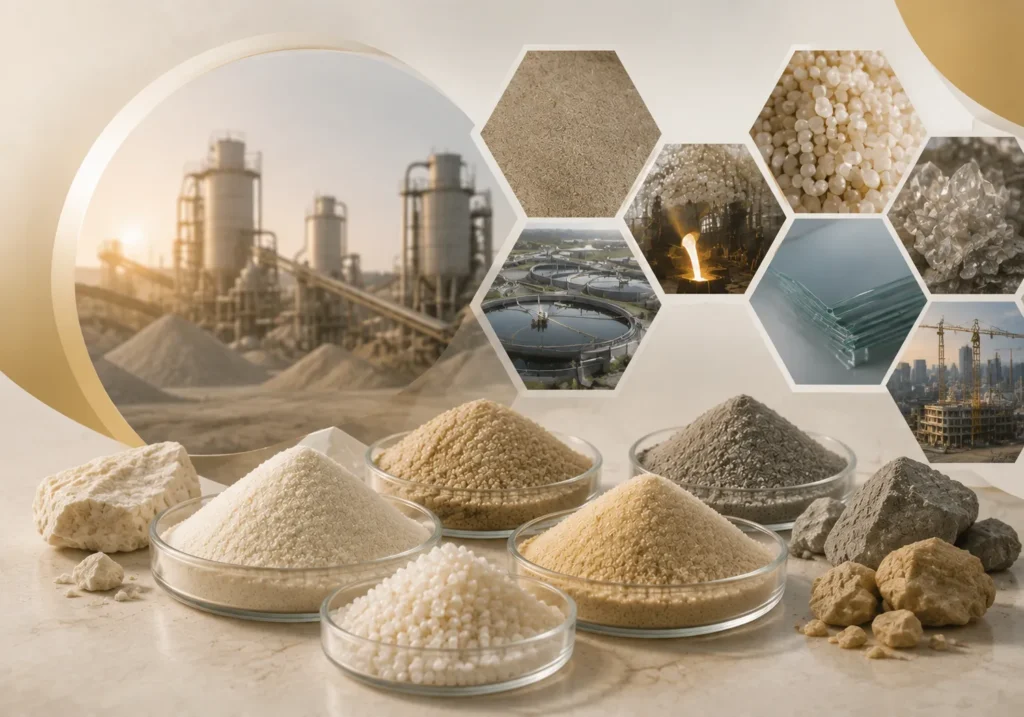

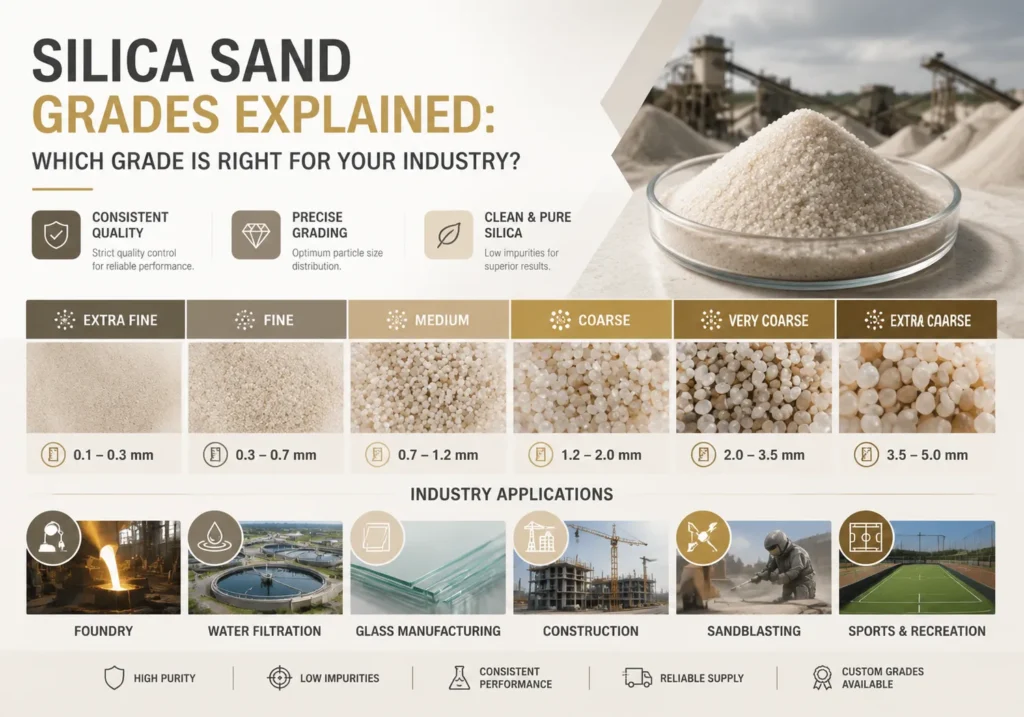
However, not all silica sand is the same. Different industries require different levels of purity, particle size, iron content, thermal resistance, and physical characteristics. Choosing the correct silica grade is therefore essential for manufacturers, importers, distributors, and procurement teams looking to achieve consistent results.
This guide explains the main silica sand grades, their technical characteristics, common applications, and the key factors industrial buyers should consider when selecting the right material.
What Is Silica Sand?
Silica sand is a naturally occurring mineral material primarily composed of silicon dioxide, commonly written as SiO₂. It is valued for its hardness, chemical stability, thermal resistance, and versatility.
The suitability of silica for industrial use depends on several factors, including:
- SiO₂ purity
- Iron content
- Particle size distribution
- Grain shape
- Moisture content
- Chemical impurities
- Thermal properties
- Processing method
Industrial silica may be washed, graded, screened, dried, ground, or micronized depending on the requirements of the final application.
Understanding these differences is essential because a silica grade designed for glass manufacturing may not be suitable for foundry molding or water filtration.
1. Glass Grade Silica Sand
Glass Grade Silica Sand is selected primarily for its high silica purity and controlled impurity levels. Iron content is especially important because excessive iron can affect the color and transparency of finished glass.
The glass industry typically requires silica with consistent chemical composition and carefully controlled particle size to support stable melting and production conditions.
Common Applications
- Flat Glass
- Float Glass
- Container Glass
- Bottle Glass
- Crystal Glass
- Architectural Glass
- Fiberglass Production
Key Characteristics
Glass-grade silica generally prioritizes:
- High SiO₂ content
- Low iron content
- Controlled grain size
- Consistent chemical composition
- Stable processing characteristics
For applications involving clear or high-transparency glass, impurity control becomes especially important.
Who Uses It?
Glass manufacturers, fiberglass producers, raw material importers, industrial distributors, and companies supplying mineral inputs to glass factories are among the main buyers of this grade.
2. Foundry Grade Silica Sand
Foundry Grade Silica Sand is designed for metal casting and molding applications. In foundries, silica sand is commonly used to form molds and cores that must withstand extremely high temperatures when molten metal is poured.
Unlike glass applications, where chemical purity may be the dominant concern, foundry applications depend heavily on grain size, thermal performance, permeability, and mold behavior.
Common Applications
- Steel Casting
- Iron Casting
- Sand Molding
- Green Sand Systems
- Core Making
- Industrial Metal Components
Key Characteristics
Foundry-grade silica typically requires:
- High thermal resistance
- Controlled grain size distribution
- Good moldability
- Suitable permeability
- Consistent particle characteristics
- Reliable performance under high temperatures
Particle size is particularly important. If the sand is too fine, permeability may decrease. If it is too coarse, casting surface quality may be affected.
Manufacturers therefore need to select silica sand according to their molding system, casting metal, binder system, and required surface finish.
3. Filter Grade Silica Sand
Filter Grade Silica Sand is processed for water treatment and filtration applications. It is generally washed and graded to achieve controlled particle sizes and remove unwanted fine material.
In filtration systems, silica sand acts as a physical filtration medium. Water passes through layers of silica, while suspended solids and particles are trapped within the filter bed.
Common Applications
- Drinking Water Filtration
- Municipal Water Treatment
- Industrial Water Treatment
- Swimming Pool Filters
- Wastewater Treatment
- Multi-Media Filtration Systems
Key Characteristics
Important properties include:
- Controlled particle size
- High mechanical durability
- Good abrasion resistance
- Cleanliness
- Stable grain structure
- Long service life
The required grain size depends on the design of the filtration system and the type of contaminants that need to be removed.
A well-graded filtration medium helps maintain an appropriate balance between filtration efficiency and water flow.
4. Micronized Silica Powder
Micronized Silica Powder differs from conventional silica sand because it is processed into a much finer particle size.
It is widely used as a functional mineral filler in industrial formulations where manufacturers require fine particles, chemical stability, good dispersion, and compatibility with other materials.
Common Applications
- Paints & Coatings
- Plastics
- Resins
- Adhesives
- Ceramics
- Composite Materials
- Polymer Compounds
- Industrial Fillers
Key Characteristics
Micronized silica is typically selected for:
- Fine particle size
- Uniform particle distribution
- High chemical stability
- Good dispersion
- Improved surface characteristics
- Compatibility with polymers and resins
Depending on the formulation, micronized silica can contribute to mechanical strength, dimensional stability, surface finish, and overall product consistency.
How to Choose the Right Silica Sand Grade
Selecting the correct silica grade should begin with the intended application rather than simply choosing a material based on price or general purity.
Industrial buyers should evaluate several important factors.
1. Chemical Composition
The required SiO₂ content and acceptable impurity levels vary significantly between industries.
Glass manufacturers may focus strongly on iron content, while other industrial applications may have different chemical priorities.
2. Particle Size Distribution
Particle size affects how silica behaves during processing.
Foundries need suitable grain distribution for molding and permeability, filtration systems require carefully graded media, and industrial fillers often require fine or micronized particles.
3. Physical Properties
Depending on the application, buyers may need to evaluate:
- Hardness
- Bulk density
- Moisture
- Grain shape
- Thermal stability
- Abrasion resistance
4. Consistency Between Shipments
For industrial production, consistency is often just as important as the specification itself.
Changes in particle size, chemical composition, or moisture content can influence manufacturing performance and force producers to adjust their formulations or process conditions.
5. Packaging and Supply Volume
B2B buyers should also consider how the material will be packed, handled, stored, and transported.
The most appropriate packaging depends on order quantity, product characteristics, production requirements, and destination.
Quick Comparison of Silica Sand Grades
| Silica Grade | Main Application | Key Requirement |
|---|---|---|
| Glass Grade Silica Sand | Glass Manufacturing | High Purity & Low Iron |
| Foundry Grade Silica Sand | Metal Casting | Thermal Resistance & Grain Control |
| Filter Grade Silica Sand | Water Filtration | Controlled Grading & Durability |
| Micronized Silica Powder | Paints, Plastics & Composites | Fine Particle Size & Dispersion |
Why the Correct Silica Grade Matters
Using an unsuitable silica grade can create production problems, reduce product quality, and increase operational costs.
For example, excessive iron in glass-making silica can influence finished glass color. Incorrect grain distribution in foundry sand may affect mold performance. Poorly graded filtration media can reduce filtration efficiency, while inconsistent micronized silica may change the behavior of industrial formulations.
For this reason, professional buyers should define their application, required technical parameters, expected quantity, and processing conditions before selecting a supplier or confirming an order.
Conclusion
Silica is an extremely versatile industrial mineral, but its performance depends heavily on choosing the correct grade.
Glass Grade Silica Sand is designed for high-purity glass applications. Foundry Grade Silica Sand focuses on thermal performance and controlled grain characteristics. Filter Grade Silica Sand is processed for reliable water filtration, while Micronized Silica Powder serves as a fine functional mineral filler in advanced industrial formulations.
For manufacturers and B2B buyers, the best silica grade is the one that matches the technical requirements of the production process. Evaluating purity, particle size, physical characteristics, consistency, and application requirements before purchasing can help improve production reliability and long-term sourcing efficiency.