



A reliable industrial mineral supplier should be able to provide consistent product specifications, suitable grades, clear technical information, dependable supply capacity, proper packaging, and professional commercial communication.
This guide explains the key factors B2B buyers should evaluate when selecting an industrial mineral supplier for long-term cooperation.
1. Evaluate Product Quality and Consistency
Product quality is one of the most important factors in industrial mineral procurement.
Industrial processes depend on predictable raw material characteristics. Even relatively small variations in chemical composition, particle size, moisture, whiteness, density, or other technical parameters can affect manufacturing performance.
For example, glass manufacturers may require silica with controlled iron content, while drilling companies may focus on the specific gravity of barite or the swelling capacity of bentonite.
A reliable supplier should therefore focus not only on delivering acceptable material once, but also on maintaining consistent characteristics across repeat orders.
Buyers should evaluate:
- Chemical Composition
- Purity
- Particle Size Distribution
- Moisture Content
- Physical Properties
- Product Grade
- Consistency Between Shipments
Stable raw material quality reduces the need for frequent production adjustments and helps manufacturers maintain predictable output.
2. Check Technical Specifications Before Ordering
Industrial minerals should always be selected according to their intended application.
A product described simply as “silica,” “barite,” or “kaolin” is not enough for professional B2B procurement. Each mineral can be available in multiple grades with significantly different characteristics.
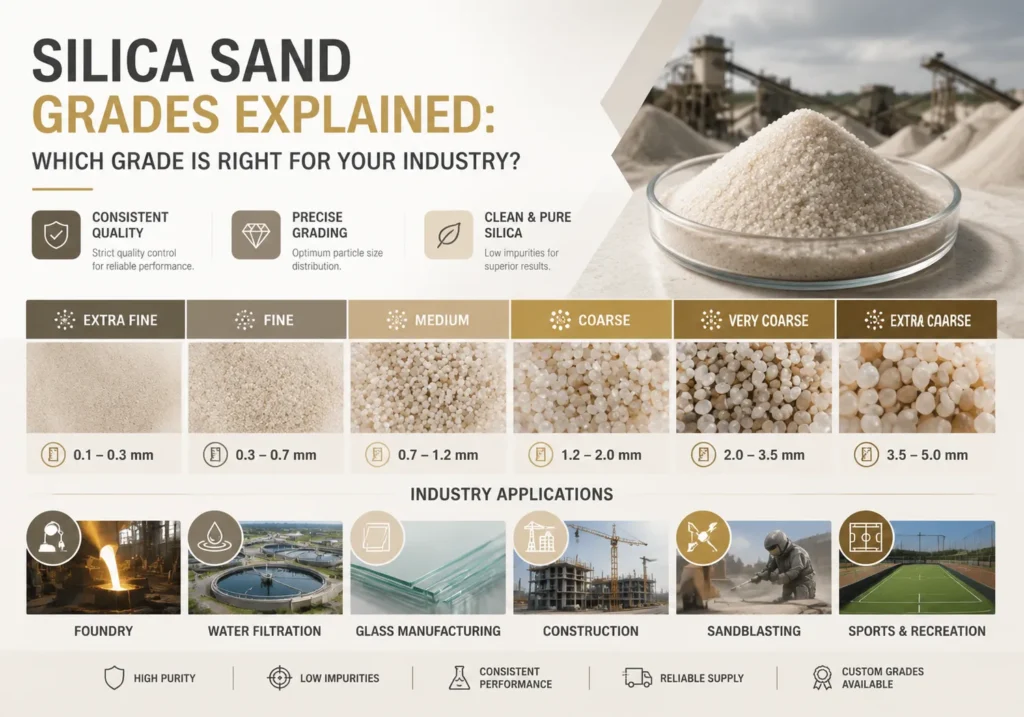
Silica, for example, may be supplied as:
- Glass Grade Silica Sand
- Foundry Grade Silica Sand
- Filter Grade Silica Sand
- Micronized Silica Powder
Similarly, bentonite used for drilling has different performance requirements from bentonite used for cat litter or foundry molding.
Before confirming an order, buyers should provide their target specifications and compare them with available product data.
Important parameters may include:
- Chemical Analysis
- Mesh or Micron Size
- Particle Size Distribution
- Specific Gravity
- Whiteness
- Swelling Capacity
- Iron Content
- Bulk Density
- Moisture Level
The more clearly technical requirements are defined, the lower the risk of receiving unsuitable material.
3. Consider the Supplier’s Product Range
A broad but relevant product portfolio can be valuable for industrial buyers sourcing multiple raw materials.
A supplier capable of providing several mineral categories may simplify procurement and reduce the number of commercial relationships a buyer needs to manage.
Common industrial minerals include:
- Silica
- Barite
- Bentonite
- Chromite
- Kaolin
Each of these materials serves different industries, including glass manufacturing, foundries, oil and gas drilling, water filtration, metallurgy, ceramics, paper, paints, plastics, rubber, animal feed, and pet care products.
However, product range should not come at the expense of technical understanding. Buyers should prioritize suppliers that can clearly identify the correct grade for each industrial application.
4. Review Supply Capacity
Reliable B2B procurement requires more than product availability at the time of the first inquiry.
Manufacturers and distributors often need regular deliveries over extended periods. A supplier should therefore be able to discuss expected quantities, repeat-order requirements, production schedules, and supply continuity.
Before selecting an industrial mineral supplier, buyers should consider:
- Monthly or Annual Supply Requirements
- Minimum Order Quantity
- Repeat Order Capability
- Production or Sourcing Capacity
- Lead Times
- Seasonal Availability
- Scalability for Larger Orders
Supply capability becomes especially important when the mineral is a critical component of continuous manufacturing operations.
5. Pay Attention to Packaging
Packaging is an important part of industrial mineral procurement because it affects handling, storage, transportation, contamination risk, and operational efficiency.
Different materials and customers may require different packaging formats depending on product characteristics and order volume.
Industrial buyers should define:
- Preferred Packaging Type
- Unit Weight
- Bulk or Bagged Supply
- Handling Requirements
- Storage Conditions
- Destination Requirements
The appropriate packaging solution can help reduce product loss and simplify warehouse and production handling.
6. Evaluate Documentation and Product Information
Clear documentation supports more efficient procurement and internal quality control.
Depending on the product and application, buyers may need access to technical specifications, available product analysis, packing details, commercial documents, and shipment information.
A professional supplier should communicate clearly about what product information is available and provide relevant documentation during the commercial process.
For many industrial buyers, documentation is especially important when products must pass internal quality checks before entering production.
7. Compare Suppliers Based on More Than Price
Price is always an important consideration in B2B procurement, but the lowest quotation does not necessarily represent the lowest total cost.
Poor-quality or inconsistent raw material can create additional expenses through:
- Production Interruptions
- Higher Waste
- Quality Control Failures
- Product Rejection
- Additional Testing
- Formula Adjustments
- Delivery Delays
A slightly more expensive but consistent material may provide greater long-term value than a cheaper product with unpredictable specifications.
Buyers should compare suppliers based on a combination of quality, consistency, service, packaging, supply reliability, and commercial terms.
8. Assess Communication Quality
Professional communication is one of the strongest indicators of a reliable B2B supplier.
Industrial procurement often involves multiple discussions about specifications, quantities, packaging, documentation, delivery schedules, and commercial conditions.
A supplier should be able to respond clearly and understand technical purchasing requirements.
Effective communication can reduce misunderstandings and speed up the procurement process, particularly in international transactions where multiple parties may be involved.
Buyers should consider whether a supplier provides:
- Clear Responses
- Accurate Product Information
- Timely Quotations
- Technical Understanding
- Transparent Commercial Communication
- Reliable Order Updates
Strong communication becomes even more valuable when developing long-term cooperation.
9. Confirm the Right Grade for Your Application
Selecting the wrong grade can cause significant manufacturing problems even if the mineral itself is technically high quality.
For example:
Glass manufacturers typically require high-purity silica with controlled iron levels.
Foundries may require silica or chromite with specific grain sizes and thermal properties.
Drilling companies may prioritize barite density or bentonite swelling and viscosity.
Ceramic producers may evaluate kaolin based on plasticity, whiteness, and firing characteristics.
The supplier should therefore understand the final application rather than treating all grades of a mineral as interchangeable.
10. Think About Long-Term Supply Relationships
For many industrial buyers, the best supplier is not simply the company offering the best conditions for one transaction.
Long-term relationships can provide significant advantages, including improved communication, better understanding of technical requirements, more predictable supply planning, and greater consistency between orders.
Before developing long-term cooperation, buyers should evaluate:
- Product Consistency
- Supply Reliability
- Responsiveness
- Technical Understanding
- Commercial Transparency
- Ability to Handle Repeat Orders
- Flexibility as Requirements Change
A dependable industrial mineral supplier should be able to grow alongside the buyer’s purchasing requirements.
Key Questions to Ask an Industrial Mineral Supplier
Before confirming a supplier, B2B buyers should consider asking:
- What grades of the mineral are available?
- What technical specifications can be provided?
- Can the required particle size be supplied?
- Is product analysis available?
- What packaging options are available?
- What is the minimum order quantity?
- Can repeat orders maintain consistent specifications?
- What quantities can be supplied regularly?
- What information is required to prepare an accurate quotation?
- Can supply requirements be customized for the intended application?
These questions help buyers compare suppliers based on actual procurement requirements rather than general marketing claims.
Industrial Mineral Supplier Checklist
| Evaluation Factor | Why It Matters |
|---|---|
| Product Quality | Affects manufacturing and final product performance |
| Consistency | Reduces production variation |
| Technical Specifications | Confirms suitability for the intended application |
| Product Range | Simplifies multi-material procurement |
| Supply Capacity | Supports continuous production |
| Packaging | Improves handling and logistics efficiency |
| Documentation | Supports procurement and quality control |
| Communication | Reduces delays and misunderstandings |
| Commercial Terms | Influences total purchasing cost |
| Long-Term Reliability | Supports stable sourcing strategies |
Conclusion
Selecting a reliable industrial mineral supplier requires a structured evaluation of both technical and commercial factors.
Manufacturers, importers, distributors, and procurement teams should assess product quality, consistency, technical specifications, supply capacity, packaging, documentation, communication, and long-term reliability before making a purchasing decision.
Whether sourcing silica, barite, bentonite, chromite, kaolin, or other industrial raw materials, the most effective approach is to define the application and technical requirements first.
A supplier that understands these requirements and can provide consistent material, clear product information, reliable commercial coordination, and repeatable supply can become an important part of a stable B2B procurement strategy.