
Choosing the correct industrial mineral is therefore not simply a matter of finding a supplier. Manufacturers and procurement teams need to identify the material and grade that best match their production process, technical requirements, and final product specifications.
This guide explains the main industrial minerals used across different industries and the key factors buyers should evaluate before making a purchasing decision.
What Are Industrial Minerals?
Industrial minerals are naturally occurring materials used primarily for their physical and chemical properties rather than for extracting metals or producing energy.
They may be used as raw materials, fillers, binders, filtration media, weighting agents, refractory materials, or functional additives.
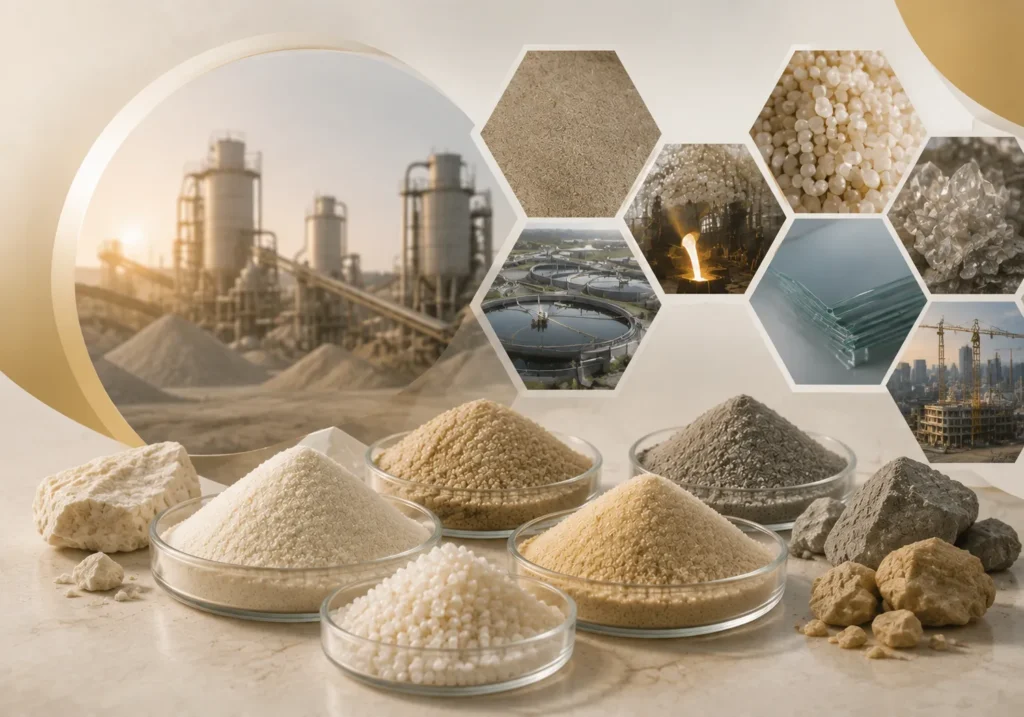
Common industrial minerals include:
- Silica
- Barite
- Bentonite
- Chromite
- Kaolin
Each mineral offers a different combination of properties and is suitable for specific production processes.
For industrial buyers, understanding these differences is critical because using an unsuitable material or grade can affect product quality, manufacturing efficiency, and production costs.
Silica: A Versatile Mineral for Multiple Industries
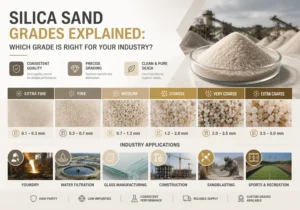
Silica is one of the most widely used industrial minerals due to its high SiO₂ content, hardness, thermal resistance, and chemical stability.
However, different industries require different silica grades.
Common Applications
Silica is widely used in:
- Glass Manufacturing
- Metal Casting
- Water Filtration
- Ceramics
- Paints & Coatings
- Plastics
- Resins
- Adhesives
- Composite Materials
Glass manufacturers generally require high-purity silica with controlled iron content, while foundries focus more heavily on grain size and thermal behavior.
Water treatment applications require washed and carefully graded silica sand, while manufacturers of paints, plastics, and composites may prefer micronized silica powder with a fine particle size.
The correct silica grade should therefore be selected according to the exact industrial application.
Barite: High-Density Mineral for Drilling and Industrial Formulations
Barite is primarily composed of barium sulfate and is known for its high specific gravity, chemical stability, and relatively low reactivity.
Its high density makes it especially important in drilling operations, although different barite grades are also used in chemicals, paints, coatings, plastics, and polymer systems.
Common Applications
Barite is used in:
- Oil & Gas Drilling
- Water Well Drilling
- Chemical Manufacturing
- Paints & Coatings
- Plastics
- Rubber
- Resins
- Cable Compounds
Drilling Grade Barite is generally selected for its high specific gravity and suitability for drilling mud systems.
Chemical Grade Barite prioritizes purity and chemical composition, while micronized and coating grades focus on particle size, whiteness, dispersion, and filler performance.
Bentonite: Swelling and Binding Performance
Bentonite is a natural clay mineral valued for its ability to absorb water, swell, bind particles, and form stable suspensions.
These characteristics make bentonite suitable for several very different industrial applications.
Common Applications
Bentonite is widely used in:
- Drilling Fluids
- Foundry Molding
- Animal Feed
- Cat Litter
- Geotechnical Engineering
- Industrial Binding Applications
Sodium bentonite used in drilling needs strong swelling and viscosity development.
Foundry Grade Bentonite is selected for bonding strength and mold performance, while Cat Litter Grade Bentonite requires high absorbency, strong clumping, controlled particle size, and low dust.
Feed Grade Bentonite may be used in animal feed formulations, subject to applicable feed regulations and specifications.
The functional requirements therefore vary considerably between grades.
Chromite: Essential for Metallurgy, Refractories and Foundries
Chromite is an important chromium-bearing mineral used primarily in metallurgical, refractory, and foundry applications.
Its suitability depends heavily on chromium content, chromium-to-iron ratio, impurity levels, thermal characteristics, and particle size.
Common Applications
Chromite is used in:
- Ferrochrome Production
- Stainless Steel Manufacturing
- Refractory Materials
- Steel Furnaces
- Cement Kilns
- Foundry Casting
- Chemical Processing
Metallurgical Grade Chromite is primarily used in ferrochrome and steel production, where chromium content and metallurgical performance are major considerations.
Refractory Grade Chromite is selected for its ability to withstand high temperatures and aggressive furnace environments.
Foundry Chromite Sand offers high heat resistance and low thermal expansion, making it suitable for demanding metal casting operations.
Kaolin: Functional Mineral for Ceramics and Industrial Fillers
Kaolin is a clay mineral widely used because of its whiteness, fine particle size, plasticity, chemical stability, and compatibility with industrial formulations.
Different processing methods create kaolin grades suitable for a wide range of applications.
Common Applications
Kaolin is used in:
- Ceramic Tiles
- Sanitary Ware
- Porcelain
- Paper Coating
- Paints & Coatings
- Plastics
- Rubber
- Adhesives
- Composite Materials
Ceramic Grade Kaolin is commonly selected for plasticity, fired color, and stable firing behavior.
Paper Coating Grade Kaolin requires fine particle size and high brightness, while Calcined Kaolin is used in formulations requiring improved whiteness, thermal stability, and functional filler performance.
Micronized Kaolin is often selected for paints, plastics, rubber, adhesives, and composite systems.
Key Factors When Selecting an Industrial Mineral
Choosing the right industrial mineral requires more than identifying the material name. Buyers should evaluate several technical and commercial parameters.
1. Chemical Composition
Chemical composition is one of the most important selection criteria.
Depending on the mineral, important values may include:
- SiO₂
- BaSO₄
- Cr₂O₃
- Al₂O₃
- Fe₂O₃
- Moisture
- Other impurities
Acceptable values depend on the intended application.
2. Particle Size
Particle size can dramatically affect material performance.
Foundry sands require controlled grain distribution, filtration media require specific grading, and mineral fillers often require micronized particles.
Buyers should therefore clearly define required mesh size, micron size, or particle size distribution.
3. Purity
Some applications require significantly higher purity than others.
For example, glass manufacturing may require silica with very low iron content, while chemical processing may require high-purity barite with controlled impurities.
4. Physical Properties
Depending on the application, relevant physical characteristics can include:
- Specific Gravity
- Whiteness
- Swelling Capacity
- Absorption
- Plasticity
- Thermal Resistance
- Bulk Density
- Abrasion Resistance
These values often determine whether a mineral performs correctly in a specific process.
5. Consistency Between Shipments
Industrial production depends heavily on repeatability.
A material that performs well in one shipment but changes significantly in the next can create problems in manufacturing, formulation, or quality control.
Professional buyers should therefore consider consistency as part of supplier evaluation, not just initial sample quality.
6. Packaging and Supply Requirements
Packaging should also match production and logistics requirements.
Buyers should consider:
- Order Volume
- Storage Conditions
- Handling Equipment
- Transportation Method
- Destination
- Packaging Format
For large-scale industrial procurement, supply continuity and packaging efficiency can have a direct impact on operating costs.
Matching the Mineral to the Application
A practical way to select an industrial mineral is to begin with the production requirement.
| Industrial Need | Suitable Mineral |
|---|---|
| Glass Manufacturing | Silica |
| Metal Casting | Silica / Chromite / Bentonite |
| Oil & Gas Drilling | Barite / Bentonite |
| Water Filtration | Silica |
| Ferrochrome Production | Chromite |
| Refractory Materials | Chromite |
| Ceramic Production | Kaolin |
| Paper Coating | Kaolin |
| Paints & Coatings | Barite / Kaolin / Silica |
| Plastics & Polymers | Barite / Kaolin / Silica |
| Cat Litter Production | Bentonite |
| Animal Feed | Feed Grade Bentonite |
This comparison provides a general starting point, but the final grade should always be selected according to specific technical requirements.
Conclusion
Selecting the right industrial mineral can have a direct impact on production efficiency, product consistency, processing performance, and final quality.
Silica is widely used in glass, foundry, filtration, and industrial filler applications. Barite is particularly valuable in drilling and high-density formulations. Bentonite provides swelling, absorption, and binding properties. Chromite is essential in metallurgy, refractory materials, and foundries, while kaolin plays an important role in ceramics, paper, paints, plastics, and other industrial formulations.
For B2B buyers, the most effective sourcing process begins with clear technical requirements. Chemical composition, particle size, purity, physical properties, consistency, packaging, and supply volume should all be evaluated before confirming an industrial mineral purchase.